
EIFS (Exterior Insulation and Finish System) have earned a bad reputation due to a history of moisture-related failures. But is EIFS inherently faulty? BK Inspections answers all!
Key Points:
- Modern EIFS is not inherently faulty when installed correctly.
- The majority of failures are due to installation errors, missing drainage, poor detailing, or physical damage — not the EIFS system itself.
- Stigma surrounding EIFS cladding stems from the early days when the system lacked drainage and could trap moisture.
Early EIFS systems were plagued with failures
These systems have spent decades trying to outrun a checkered past, primarily rooted in the building boom of the 1980s and 90s. During this era, early EIFS was designed as a “barrier system,” meaning it relied entirely on its outer surface to keep water out, with zero internal drainage for any moisture that managed to sneak past.
The real trouble started when builders installed these systems without proper flashing or sealants, and homeowners—often unaware of the maintenance requirements—neglected to upkeep those critical joints.
These factors inevitably led to “moisture traps” where water seeped in and had absolutely no way out, leading to widespread rot and very unhappy homeowners. The resulting wave of lawsuits would define the industry for years.
While the “synthetic stucco” of today is a completely different animal, the stigma remains. Modern EIFS has evolved significantly, now featuring integrated drainage planes that allow moisture to escape harmlessly.
EIFS is credited with mainstreaming the concept of wrapping a building in a thermal blanket rather than just stuffing insulation inside the cavities, creating an extremely effective thermal barrier.
However, even with these engineering improvements, the industry still suffers a negative reputation due to its early failures.
Modern EIFS failures
Moisture intrusion remains the most common cause of failure, and it almost always ties back to one or more of the following:
• Missing kickout flashing
• Bad window/door sealing
• No drainage plane
• Poor workmanship at terminations and penetrations
• Impact damage that goes unrepaired
Note that all but the last causes are install-related.
Modern EIFS itself is not inherently faulty — but it is unforgiving
It’s a high‑performance cladding/insulation combo system that depends on:
• Correct detailing
• Proper flashing
• Proper sealants
• A functioning drainage plane
• Impact protection
• Regular maintenance
When any of those are skipped, EIFS fails spectacularly because it traps moisture against the sheathing. This damage often remains hidden until it is too late and the damage is widespread.
If a failure has progressed enough to be visible, you are likely well past the early stages of failure.
EIFS is a more complex cladding system
This is one of the most technically demanding cladding systems in residential construction, consisting of insulation board, adhesive or mechanical fasteners, a base coat reinforced with mesh, and a final finish coat.
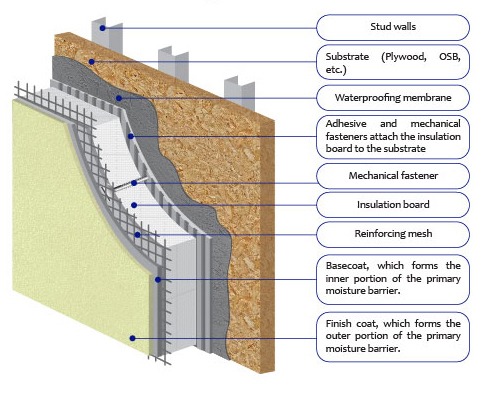
Put simply, there are many opportunities for mistakes.
Because traditional EIFS is a face-sealed, non-breathable system that lacks a drainage plane, it is notoriously unforgiving; minor installation errors frequently lead to catastrophic failure due to hidden moisture trapped behind the barrier.
In contrast, cladding systems like vinyl, brick veneer, and fiber cement (Hardie) typically utilize a ventilated rainscreen or drainage gap, providing a much higher tolerance for minor imperfections by allowing moisture to escape.
Here’s the bottom line:
EIFS provides excellent cladding and insulation when it is installed and maintained correctly.